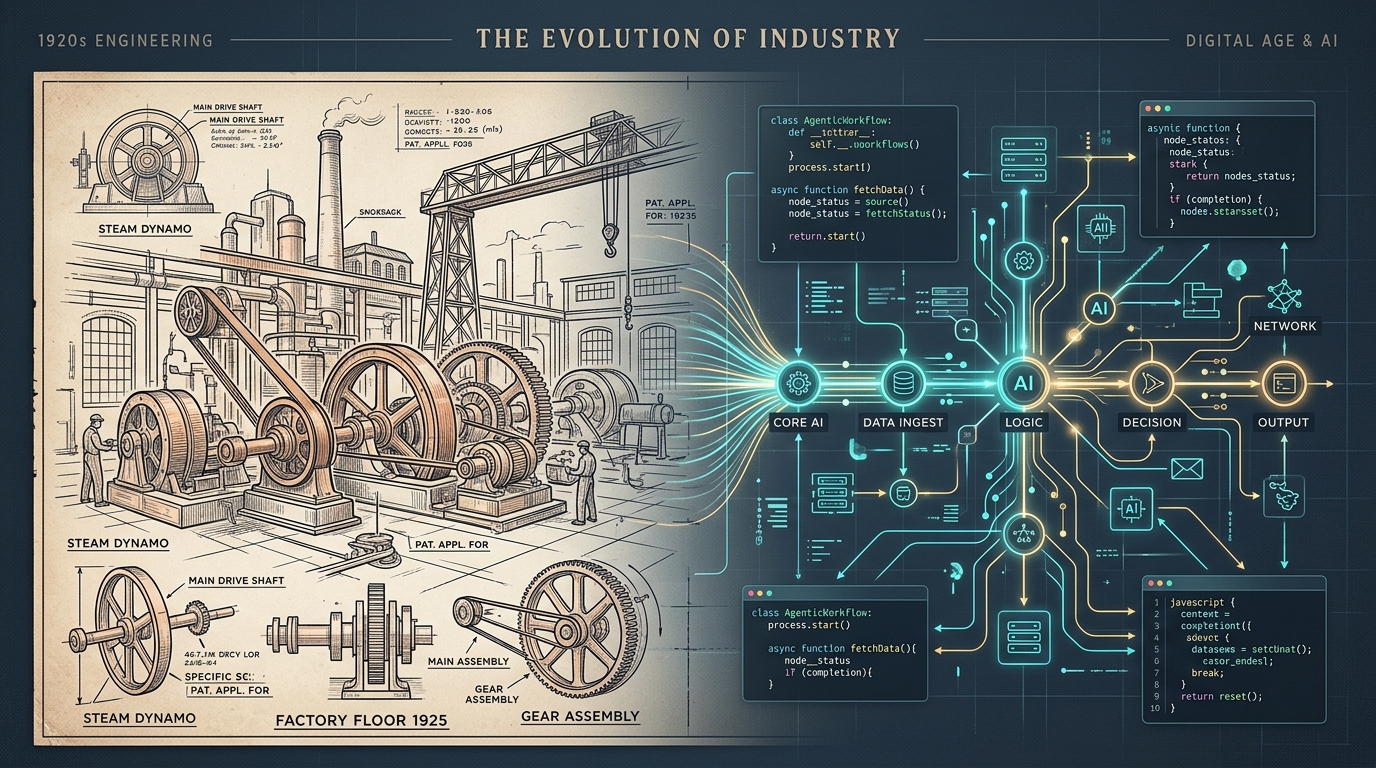
From Faster Substitution to Emergent Transformation: Historical Lessons for Enterprise AI in 2026
In September 1882, Thomas Edison threw the switch at the Pearl Street Station in lower Manhattan, unleashing electric power into the industrial world. Eager to embrace the future, 19th-century factory owners rushed to purchase electric dynamos. However, rather than redesigning their manufacturing plants, they unbolted their central steam engines and bolted electric motors onto the exact same overhead drive shafts, leather pulleys, and multi-story factory layouts.
The result was a profound historical puzzle. For nearly forty years following electrification, United States industrial productivity growth remained virtually flat, averaging under 1 percent annually. It was not until the 1920s, when a new generation of plant managers threw away steam-era process blueprints and constructed single-story assembly lines organized around distributed electrical power, that industrial Total Factor Productivity (TFP) surged by an astonishing 6 percent per year (General Purpose Technologies and Productivity Surges).
In mid-2026, enterprise artificial intelligence stands at this precise historical inflection point. Organizations across sectors are bolting advanced AI models onto pre-AI workflows, treating them as faster-and-cheaper substitutes for human labor, and expressing frustration when bottom-line financial returns fail to materialize.
The Productivity Paradox and Complementary Investments
Historical precedent reveals that breakthrough tools rarely generate outsized economic value through direct substitution alone. The lag between technological availability and measurable productivity growth is governed by the necessity of complementary organizational investments.
Economic research by Erik Brynjolfsson and Lorin Hitt demonstrated that for every single dollar a business spends on IT hardware and software, it must invest up to ten dollars in complementary organizational redesign, workforce retraining, and process restructuring to capture the technology’s full value (Productivity Paradox). Companies that simply layer software onto legacy operations gain marginal speedups, whereas those that combine technology with decentralized decision-making and redesigned operating models achieve structural competitive advantages.
Corporate history illustrates this fundamental divergence:
- Walmart integrated barcode scanning and electronic data interchange (EDI) not merely to speed up checkout counters, but to create a cross-docking logistics model that cut inventory holding costs and expanded productivity at roughly three times the retail industry average.
- Dell leveraged integrated IT systems to eliminate traditional retail distribution entirely, establishing a build-to-order manufacturing architecture that achieved inventory turns unattainable by conventional competitors.
- JPMorgan Chase developed its COiN machine learning platform to review commercial loan agreements in seconds rather than 360,000 legal hours annually, while simultaneously restructuring legal workflows to shift professionals from document inspection to complex advisory functions.
The 2026 Enterprise AI Paradox: Stuck in Task Substitution
Enterprise AI metrics in 2026 confirm that most organizations remain trapped in the initial substitution phase. Data from Deloitte indicates that while 66% of organizations report achieving productivity and efficiency gains from AI adoption, only 20% report achieving increased revenue or product/service innovation (State of AI in the Enterprise). Furthermore, 37% of companies deploy AI at a surface level with minimal changes to existing processes, while only 34% use AI to deeply transform their operations or invent new business models.
This gap between task-level automation and financial impact has created widespread ROI friction across major enterprises:
- At scale, only about 5% of companies achieve substantial financial ROI from AI, while 35% report partial returns (Master of Code).
- Research compiled by Terminal X highlights MIT data showing that 95% of enterprise AI pilots deliver zero measurable impact on company profit-and-loss statements (Terminal X).
- S&P Global reports that 42% of companies abandoned the majority of their AI projects in 2025, a failure rate more than double that of 2024.
- An IBM CEO study found that only 25% of AI initiatives delivered expected financial ROI, while PwC’s Global CEO Survey revealed that 56% of CEOs report no significant economic benefit.
- Morgan Stanley noted that by late 2025, only 21% of S&P 500 companies could cite quantifiable financial gains from AI deployments.
Capital markets are beginning to penalize organizations that spend aggressively on AI without evidence of structural return. Research compiled by Terminal X notes a Citi finding of a 30 basis point credit spread penalty for heavy AI spenders lacking clear return metrics. As synthesized in market research by Bizzdesign, Forrester predicts an enterprise market correction, forecasting that companies will defer 25% of planned 2026 AI budgets into 2027 (Enterprise AI Adoption).
Operational Bottlenecks: Governance, Infrastructure, and Measurement
Transitioning from task substitution to structural transformation requires overcoming deep operational bottlenecks. According to research by Bizzdesign, over 70% of companies report scaling or integrating AI, yet only one-third possess the governance frameworks necessary to evaluate autonomous outputs, and just 21% actively measure investment impact.
Data infrastructure and technical debt present additional operational hurdles:
- Nearly two-thirds of enterprise organizations lack the foundational data management practices required for agentic AI workflows.
- Terminal X estimates that 80% of the effort required to advance an AI system from pilot to production involves data engineering, governance architecture, and workflow integration rather than model selection.
- An IIF and EY survey found that 96% of financial institutions struggle with noisy, untimely, or inaccurate data feeds.
- A survey compiled by Terminal X from Bank Director revealed that 82% of bank directors do not measure ROI on technology investments, while S&P Global found that 91% of bank boards approved AI programs despite only 26% possessing the technical capability to execute them.
When AI models are introduced into legacy environments without modernized data pipelines or explicit governance rules, projects stall in perpetual pilot phases or generate uncoordinated “AI sprawl” that inflates operating costs.
Strategic Roadmap: How Industry Leaders Must Adapt
To break out of the substitution trap, business and technology leaders must align their AI deployment strategies with historical transformation patterns.
1. Audit for Workflow Redesign, Not Tool Adoption
Tracking login volume, seat licenses, or copilot usage provides a misleading proxy for business transformation. Leaders must audit whether AI is altering how decisions are made, cycle times are structured, and handoffs are executed. If AI is merely speeding up steps on a 2020 process map, value capture will remain capped.
2. Redesign One End-to-End Workflow Before Scaling
Rather than spreading small AI pilots thinly across dozens of departments, organizations should select a single core operational workflow and redesign it end-to-end around autonomous capabilities. Establishing full operational ownership surfaces governance and data friction early, providing a validated blueprint for broader scaling.
3. Transition to Return-on-Autonomy (RoA) Frameworks
Traditional cost-reduction scorecards fail to capture the strategic value of improved decision quality, reduced latency, and emergent capabilities. Enterprise measurement systems must evolve toward tracking Return-on-Autonomy: measuring how shifts from manual oversight to automated agentic execution expand operational capacity.
What to Expect by 2027
The trajectory of enterprise AI will mirror the diffusion curve of the electric dynamo. By 2027, the market distinction between companies that added AI tools to legacy structures and those that redesigned their operating models around AI will become starkly visible in financial earnings. Organizations that commit to complementary process restructuring, governance modernization, and data architecture today will capture the emergent economic returns of the next industrial era.
Sources
- Productivity Paradox, Strategy Lexicon (2026)
- General Purpose Technologies and Productivity Surges: Historical Reflections on the Future of the ICT Revolution, RePEc (2005)
- AI ROI: Why Only 5% of Enterprises See Real Returns in 2026, Master of Code (2026)
- The State of AI in the Enterprise - 2026 AI report, Deloitte US (2026)
- Enterprise AI Adoption: Balancing Innovation and ROI in 2026, Bizzdesign (2026)
- AI ROI in 2026: Why Enterprise AI Fails & Works, Terminal X (2026)